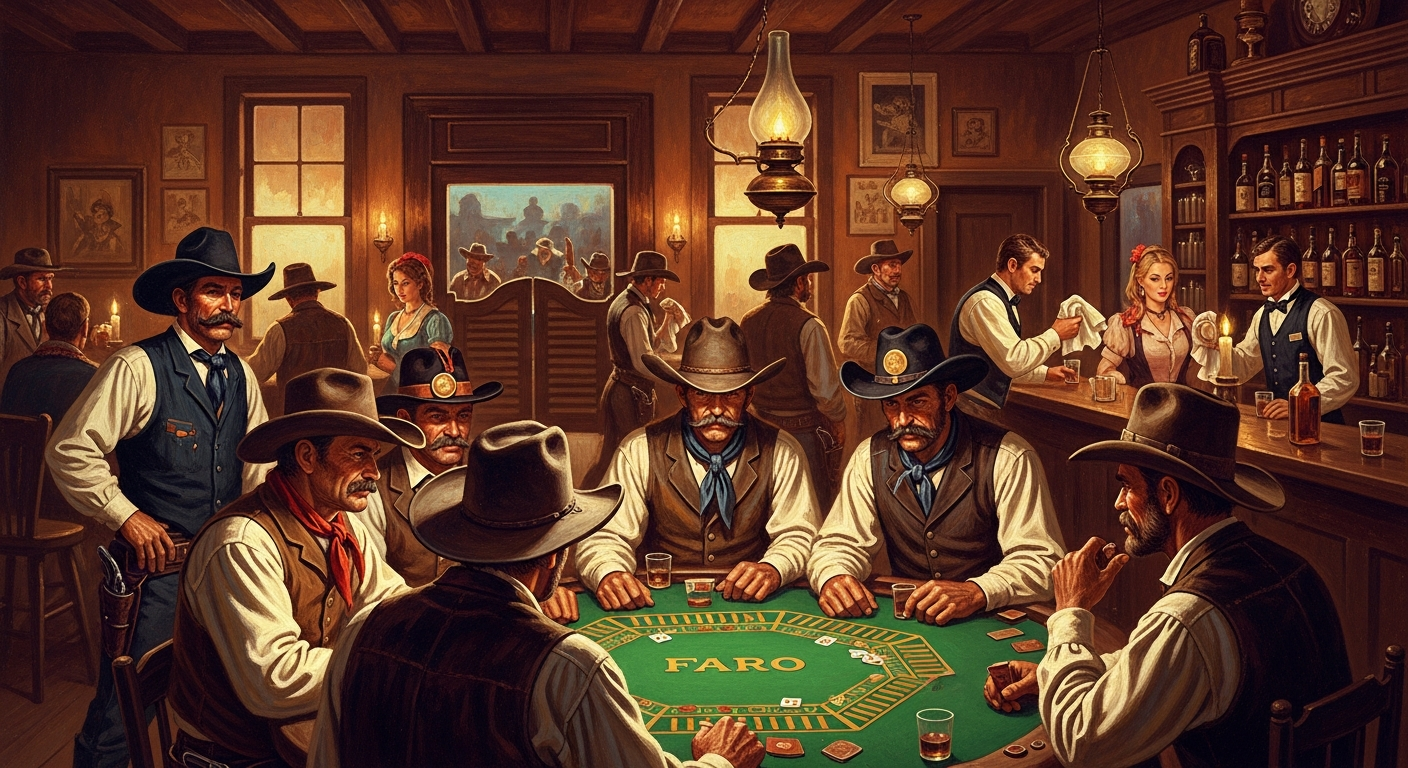
The California Gold Rush of 1849 did for faro what oxygen does for fire. Faro originated in France in the late 17th century. First known as Pharaon, it became extremely popular in Europe in the 18th century. With its name shortened to Pharo or Faro, it soon spread to America and became the favored game during the California Gold Rush. The game then spread into gambling halls all over the American Frontier, with such illustrious names as Doc Holliday and Wyatt Earp often performing the task of a Faro Dealer.
Everywhere gold was found, faro tables appeared. Mining camps, supply towns, cattle depots — any place where men gathered with money they hadn’t yet figured out how to spend. It was played in almost every gambling hall in the Old West from 1825 to 1915. Faro could be played in over 150 places in Washington, D.C. alone during the American Civil War. An 1882 study considered faro to be the most popular form of gambling, surpassing all others forms combined in terms of money wagered each year.
The game earned its most colorful American nickname from the backs of playing cards. In the US, faro was also called “bucking the tiger” or “twisting the tiger’s tail,” a reference to early card backs that featured a drawing of a Bengal tiger. By the mid 19th century, the tiger was so commonly associated with the game that gambling districts where faro was popular became known as “tiger town,” or in the case of smaller venues, “tiger alley.” Some gambling houses would simply hang a picture of a tiger in their windows to advertise that a game could be played there.
The appeal was straightforward. Faro was fast — much faster than poker. Its design favored the player with odds better than any modern casino game. A man could walk in, place a bet, and know his result in seconds. The game could accommodate an unlimited number of players around the table. And unlike poker, it required no skill — only nerve, and a good read of the odds.
Pick your favorite character from the Old West, and they surely played more than a few hands of faro. Wyatt Earp notably dealt faro at his saloon in Tombstone, Arizona, before some disagreements with local outlaws prompted him to move on. John “Doc” Holliday spent much of his life as a traveling faro dealer.
The real story of Doc Holliday is almost entirely a faro story. In 1875, a faro dealer named Tom McKey bucked the suckers at Babbitt’s House in Denver, working alternatively as dealer and lookout. He moved on in the summer of ’76 to Cheyenne, where he ran a bank in Ford’s Place. Presumably, no one who bet at the nimble-fingered McKey’s layout knew he was actually a Georgia-born dentist named John Henry ‘Doc’ Holliday. Doc found gambling more lucrative and satisfying than yanking molars, and it was a trade he plied across the West throughout his brief life. In 1880, Doc ran a bank at the Alhambra Saloon in Tombstone, a venture shared with perhaps the West’s best-known faro dealer, Wyatt Earp.
The tension at a faro table was legendary, and it sometimes turned deadly. One such occasion that clearly showed the quick and violent code was when Doc Holliday was dealing Faro to a local bully named Ed Bailey in Fort Griffin, Texas. Bailey was unimpressed with Doc’s reputation, and in an attempt to irritate him, he kept picking up the discards and looking at them. Though Holliday warned Bailey twice, the bully ignored him and picked up the discards again. This time, Doc raked in the pot without showing his hand or saying a word. Bailey immediately brought out his pistol from under the table, but Doc’s lethal knife slashed the man across the stomach before the man could pull the trigger.
The 19th-century dentist and gambler John “Doc” Holliday dealt faro in the Bird Cage Theater as an additional source of income while living in Tombstone, Arizona. The Bird Cage Theater in Tombstone — one of the most infamous establishments in American history — ran faro tables around the clock, 24 hours a day, seven days a week.
During his sojourn in Tombstone, Earp owned gambling interests in several saloons, sharing the green cloth with his brothers and a cadre of Earp allies, most notably Holliday, Luke Short and Bat Masterson. He not only dealt but also, like a true aficionado, avidly bucked the bank.
Bat Masterson was another faro man through and through. In June 1902, William Barclay “Bat” Masterson was arrested in New York City. Bat was accused of being part of a gang that had run brace games from Arkansas to New York, and had fleeced a Mormon elder of $17,000. The case was soon dismissed when the elder suffered either a change of heart or a lapse of memory.
In the 1993 film Tombstone, Doc Holliday asks his pal Wyatt Earp, “Since when is faro a business?” Holliday follows up with the wry observation, “Only suckers buck the tiger; the odds are all on the house.” Catchy dialogue, but historically it would seem to miss the mark — a thing the real John Henry Holliday rarely did. Dentistry never got Doc much beyond a nickname, but for him and many contemporaries, faro, mainstay of saloons and gambling houses across the Wild West, was indeed a business — generally lucrative and often respectable, if rarely honest.
Faro was not only a man’s game. Many women, tired of Victorian society’s strict codes and prescribed roles, sought adventure in the gaming houses. Saloonkeepers quickly discovered that a pretty dealer boosted business, and many a faro bank featured a lady behind the dealing box. Poker Alice, despite the nickname, was a skilled faro dealer. Born in England in 1851, she turned cards in Colorado boom towns like Leadville and Creede, as well as in Tombstone, and lived to be nearly 80. In contrast, Deadwood’s Kitty LeRoy, aptly nicknamed Kitty the Schemer, died at age 28, shot by her fifth husband.
Deadwood, Dodge City, Tombstone, Virginia City — in every one of these legendary frontier towns, faro was the center of gravity. One Kansas City bank in the late 1880s reported a 30-day take of nearly $64,000. In today’s money, that’s over two million dollars in a single month from a single faro operation.
William Owen “Buckey” O’Neill — future hero of the Spanish-American War and Rough Rider with Teddy Roosevelt — earned his famous nickname not on the battlefield but at the faro table. In his early 20s he became drawn to the excitement of card games on Whiskey Row, especially faro, and “bucked the tiger” (went against the odds) with such enthusiasm that he earned his nickname of “Buckey.”