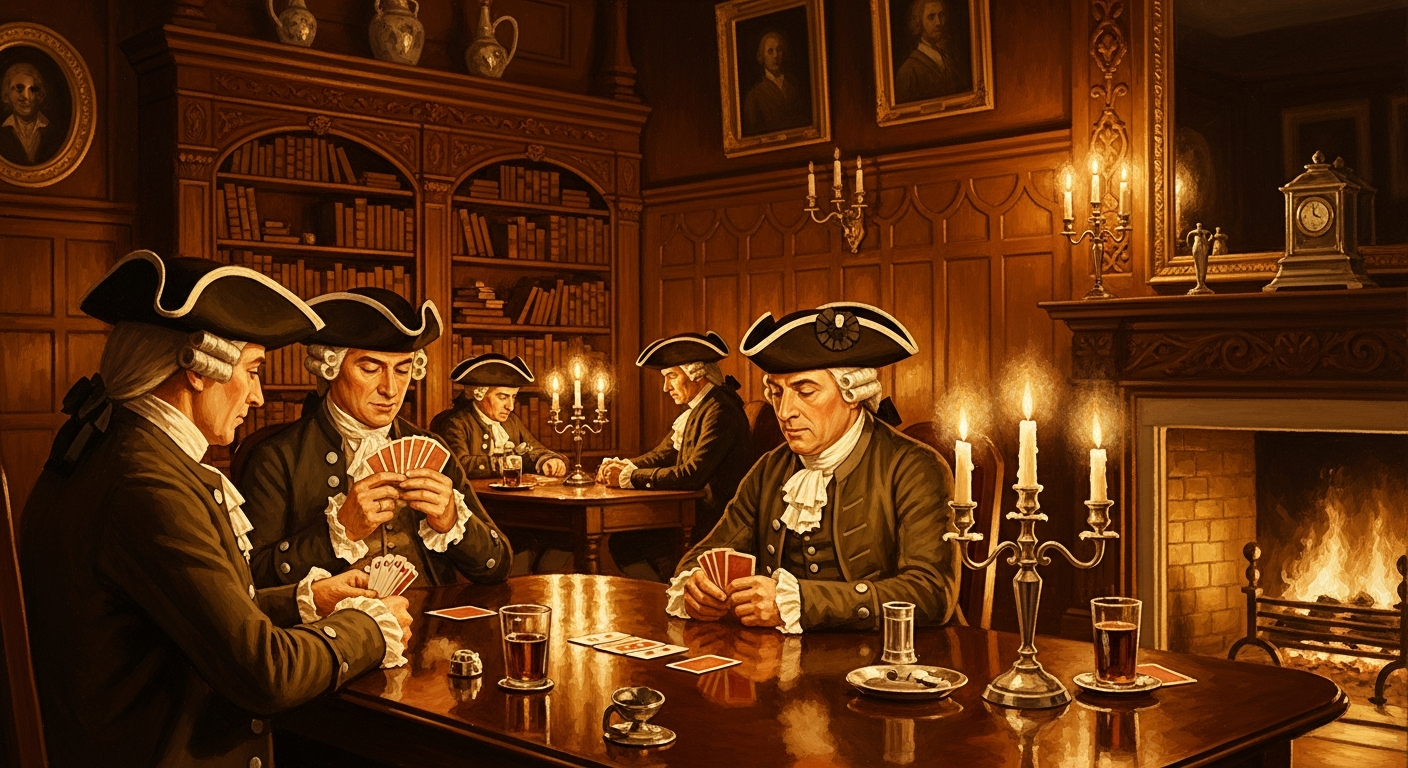
When Pharaon jumped the English Channel, it became Pharo — and found an even more enthusiastic audience. After the French ban, pharaoh and basset continued to be widely played in England during the 18th century, where it was known as pharo, an English alternate spelling of pharaoh. The game was easy to learn, quick, and when played honestly, the odds for a player were considered by some to be the best of all gambling games, as Gilly Williams records in a letter to George Selwyn in 1752.
That letter from Gilly Williams is one of the most important documents in faro’s history. Williams was writing to George Selwyn — the famous wit and MP who was one of the great gossips of Georgian England — and his casual observation that pharo offered better odds than any other game became something of a legend. It spread through the gambling set like gospel: play faro, the odds are yours.
Georgian London was a city obsessed with gambling. The great clubs of St. James’s — Brooks’s, White’s, Boodle’s — were temples to chance. Men bet on horse races, cricket matches, when the first raindrop would fall, and whether a man crossing the street would make it. Pharo tables sat at the center of all of it.
Charles James Fox, the British statesman, was known for his faro sessions. Fox was one of the most brilliant and dissolute men of his age — a Whig radical, a gifted orator, a lifelong friend of the Prince of Wales — and he was catastrophically addicted to the faro table. He reportedly lost enormous sums, and his political enemies used his gambling as evidence of his unfitness for office. Yet he kept playing. Faro had him by the throat, as it had countless men of his class and era.
Meanwhile, the 18th-century adventurer and author Casanova was known to be a great player of faro. He mentions the game frequently in his autobiography. For Casanova, faro was more than recreation — it was income. In an era when a charming rogue could finance his lifestyle through the gambling table, faro was an ideal vehicle. It was the game of sophisticates, played in drawing rooms and candlelit salons across Venice, Paris, Prague, and Vienna. Giovanni Jacopo Casanova, an 18th century Italian adventurer and writer, in his autobiography, depicts faro as it was played in 18th century Europe; the game evidently was one of the rogue’s primary sources of income.
The 18th-century Prussian officer, adventurer, and author Friedrich Freiherr von der Trenck makes mention of playing faro in his memoirs. The 18th-century Dutch cavalry commander Casimir Abraham von Schlippenbach also mentions the game (as Pharaon) in his memoirs. Apparently, he was able to win considerable sums of money with the game.
Faro was the connective tissue of an entire class of European society — soldiers, politicians, adventurers, writers, aristocrats — all sitting at the same table, watching the same cards turn.