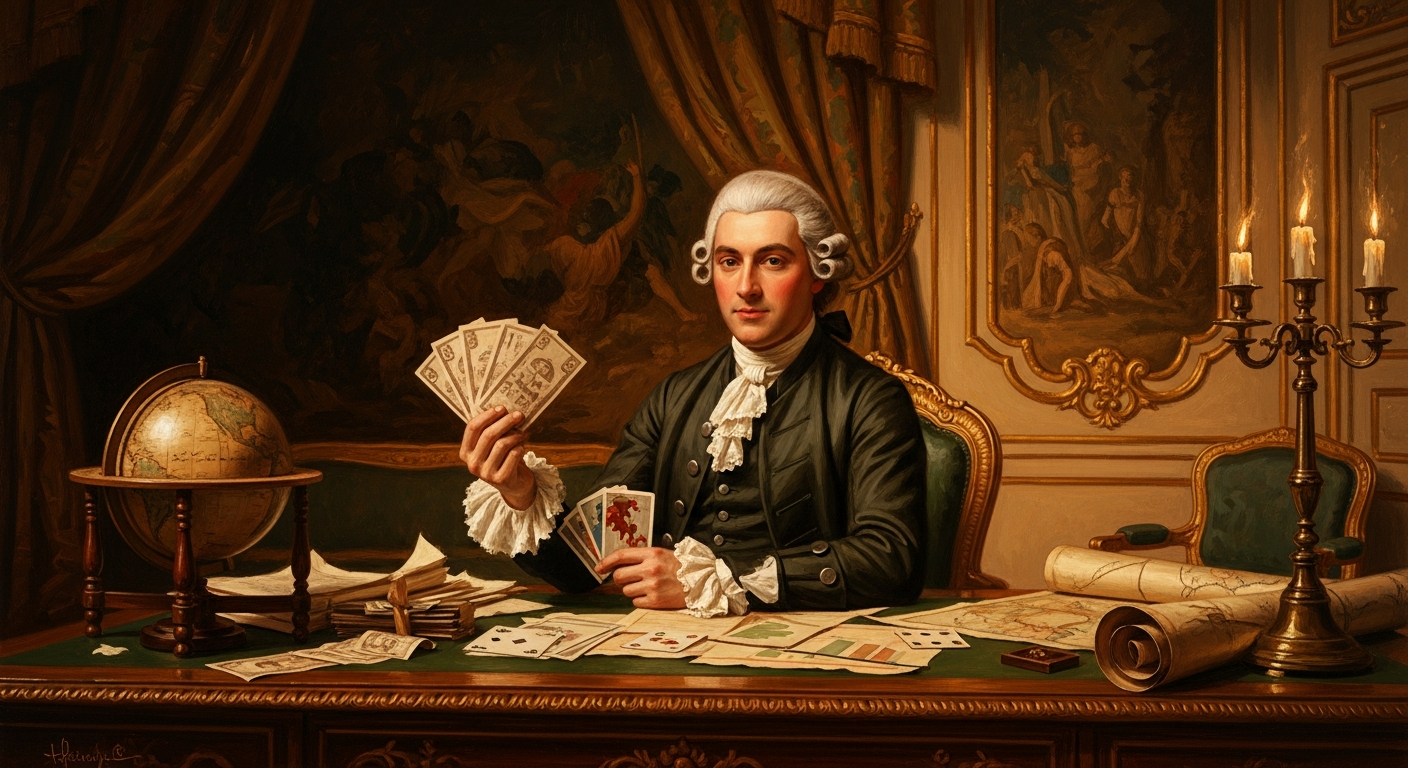
The man who brought faro to America was a murderer, a financial revolutionary, a con man, and one of the most brilliant minds of the 18th century — often simultaneously.
John Law was born in Edinburgh in 1671, the son of a goldsmith who became a banker. In his youth, he participated in a duel in England; because his victim was the son of a prominent politician, he was forced to flee England. He spent the next years drifting through the gambling dens and counting houses of Europe, studying both money and cards with the same obsessive attention.
What he concluded — and he was essentially right, which is what makes the story so extraordinary — was that money itself was a fiction. Value was not stored in gold and silver; it was created by credit, by trust, by the circulation of paper backed by productive enterprise. This was a radical idea in 1700. Most governments treated it as dangerous lunacy.
France, in the aftermath of Louis XIV’s ruinous wars, was desperate enough to try it.
Law returned to France after the Sun King’s death and found a receptive audience in Philippe II, the Duke of Orléans, who was regent for the young Louis XV. With the help of his friend Philippe, he went on to form the Royal Bank of France and print the first government-backed paper currency. He then established the Mississippi Company, which held a monopoly on trade with France’s North American territories and became the vehicle for the most spectacular speculative bubble of the early modern era. Shares in the company rose 3,600 percent in a year. Law was briefly the most powerful man in France.
Then the bubble collapsed. Law had issued more paper than the underlying enterprise could support, and when investors began to suspect it, the run began, and could not be stopped. Louis XIV expelled Law from France in 1714 for accruing heavy gambling debts on behalf of the King’s nephew. When the system fell, Law fled France as he had fled England — a fugitive from consequences he had set in motion.
But somewhere in the middle of all of this financial chaos, Law had introduced faro to the Americas. Scottish expatriate John Law introduced an early version of the game in the Americas around 1717 in what was to become the city of New Orleans.
The game took root in New Orleans in ways that Law could never have predicted. It spread up the Mississippi River on the riverboats that became the arteries of American commerce. It followed the Gold Rush west to California. It rode the cattle drives north to Kansas. It arrived in the mining camps of Colorado, Nevada, and Alaska.
By the time Law died in Venice in 1729, nearly penniless and long forgotten, the game he had carried across the Atlantic was well on its way to becoming the defining pastime of the American frontier.
The man who invented the modern concept of paper currency — and then watched it destroy him — left behind, as his most durable legacy, a card game that nearly ruined as many men as his monetary theories did. There is a poetry to that which Law would have appreciated.