Jefferson Randolph Smith II was born in 1860 in Coweta County, Georgia, to a respectable family of plantation owners and lawyers. The Civil War destroyed all of that. By the time he arrived in Texas as a teenager, there was nothing left to inherit and no particular reason to be honest.
He learned to be dishonest at a professional level.
His nickname came from a con so brilliantly simple it bordered on art: Smith piled ordinary soap cakes onto a display case and tripod, began expounding on their wonders, pulled out his wallet and began wrapping paper money — ranging from one dollar up to one hundred dollars — around a select few bars. He then sold the soap to the crowd for one dollar a cake. A shill planted in the crowd would buy a bar, tear it open, and loudly proclaim that he had won some money, waving it around for all to see. Through sleight of hand, Smith ensured the “money” bars only went to members of his gang.
He was Soapy Smith. And the soap racket was just the beginning.
By the 1880s, Soapy had built what could only be described as a criminal empire in Denver, Colorado. He had police on his payroll, politicians in his pocket, and a gang of professional con men and gamblers called the Soap Gang operating across the city. He quickly became a well-known crime boss and eventually the “king of the frontier con men.”
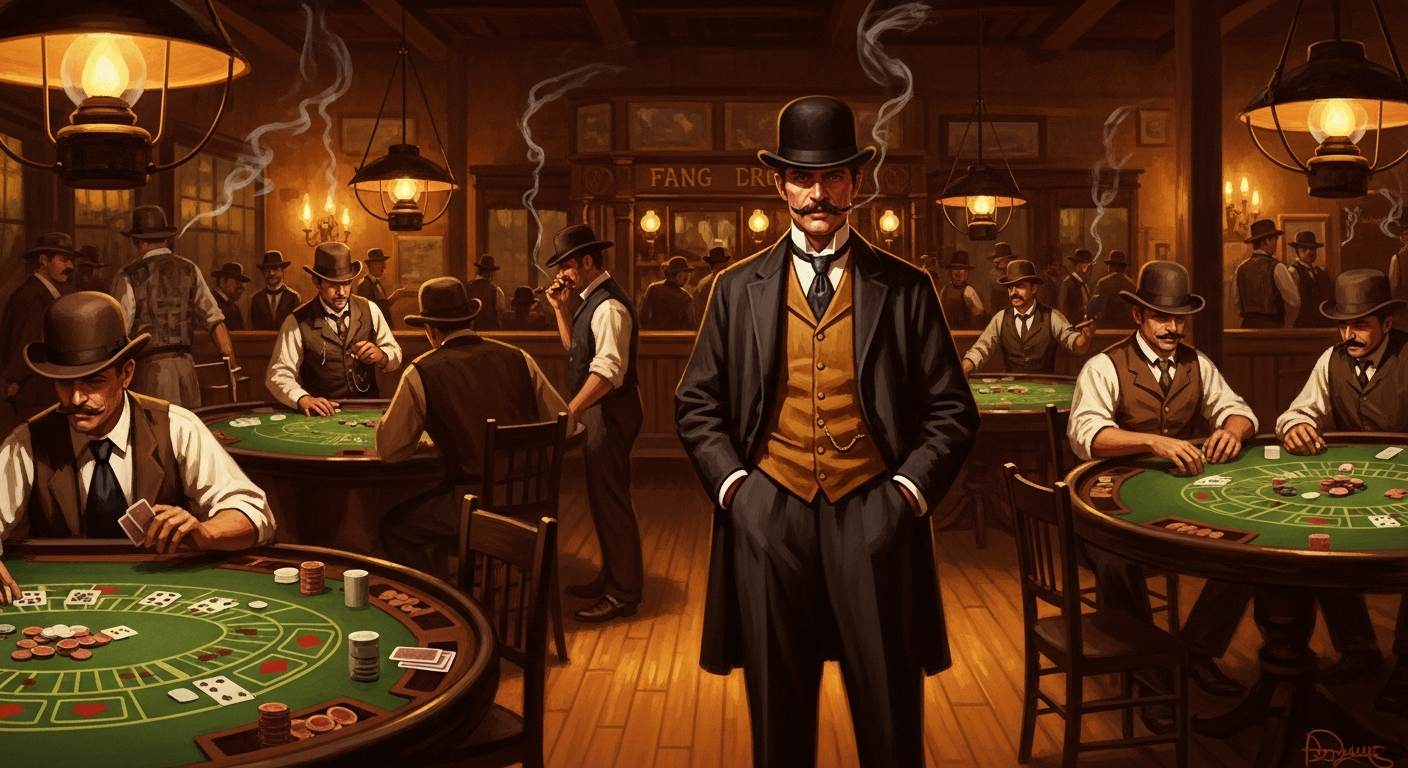
At the center of Soapy’s operation was faro. The 19th-century American con man Soapy Smith was a faro dealer. It was said that every faro table in Soapy’s Tivoli Club in Denver, Colorado, in 1889 was gaffed.
Every single table. Not one run honestly. The dealing boxes were modified. The decks were marked and stacked. The mechanics were trained to slide bets off winning cards before the deal was complete. A player sitting down at Soapy’s faro table was not gambling — they were being systematically relieved of their money by a machine that had been engineered specifically for that purpose.
And yet men kept sitting down. Because faro had a reputation — earned by the honest version of the game — for being the fairest game in the house. Players trusted it. Soapy exploited that trust with mechanical efficiency.
Denver eventually became too hot. Reform movements, rival gangs, a governor willing to call out the National Guard — Soapy relocated to Creede, a silver-mining boomtown, and then, when the gold rush began in 1897, made the journey that would define his legend: north, to Skagway, Alaska.
In Skagway, Soapy essentially ran the town. Working from his saloon named Jeff Smith’s Parlor, Soapy’s cons began once again in earnest. His saloon soon became known as the ‘real city hall,’ even though Skagway had an official one.
He bribed the deputy marshal. He bought a newspaper editor. He ran a fake telegraph office — “Of course there was no actual telegraph line to Skagway, but maybe you didn’t know that, so you could still pay for the telegraph to your loved ones, and then the reply would come saying ‘please send money.’” — and a fake information bureau for newly arrived stampeders, staffed by members of his gang who would steer newcomers toward rigged games.
The town’s legitimate businessmen organized against him. The vigilante leaders posted handbills around Skagway ordering the “bunco men” to leave the town or face the consequences. Smith retaliated by forming his own “law and order committee” but he claimed his consisted of “317 citizens.”
The breaking point came on July 8, 1898. A Klondike miner named John Douglas Stewart arrived in Skagway with $2,600 worth of gold dust from his claim — a fortune he’d spent months extracting from frozen ground. Around 10:00 AM, Stewart was met by two members of Soapy Smith’s gang. By the end of the interaction, his gold was gone. The vigilantes of Skagway demanded it back. Soapy refused.
That night, the vigilantes held a meeting on the Juneau Wharf. Smith tried to crash the vigilante meeting, apparently hoping to use his con-man skills to persuade them that he posed no threat to the community. Smith, however, had failed to realize just how angry the vigilantes were. When he tried to break through the crowd, a Skagway city engineer named Frank Reid confronted him. The men exchanged harsh words and then bullets. Reid shot Smith dead on the spot, but not before Smith had badly wounded him. The engineer died 12 days later.
Soapy’s last words were reportedly: “My God, don’t shoot!”
The funeral services for Soapy Smith were held in a Skagway church he had donated funds to help build. The minister chose as the text for his sermon a line from Proverbs XIII: “The way of transgressors is hard.”
Soapy was 37 years old. He had run three criminal empires across the American frontier, all of them built on the back of rigged faro tables and fast talk, and he had died the way every gambler who ever lived in that world knew he might: in a flash of gunfire, without warning, his luck finally run out.
On July 14, 1898, six days after the robbery and gunfight, John Stewart’s gold was found by vigilantes inside Soapy’s trunk located in an outbuilding behind Jeff Smith’s Parlor. All but $600 of the gold was there.
In Skagway, Alaska, July 8 has been the annual Soapy Smith Wake since 1974. They toast him every year. He would have appreciated the irony.