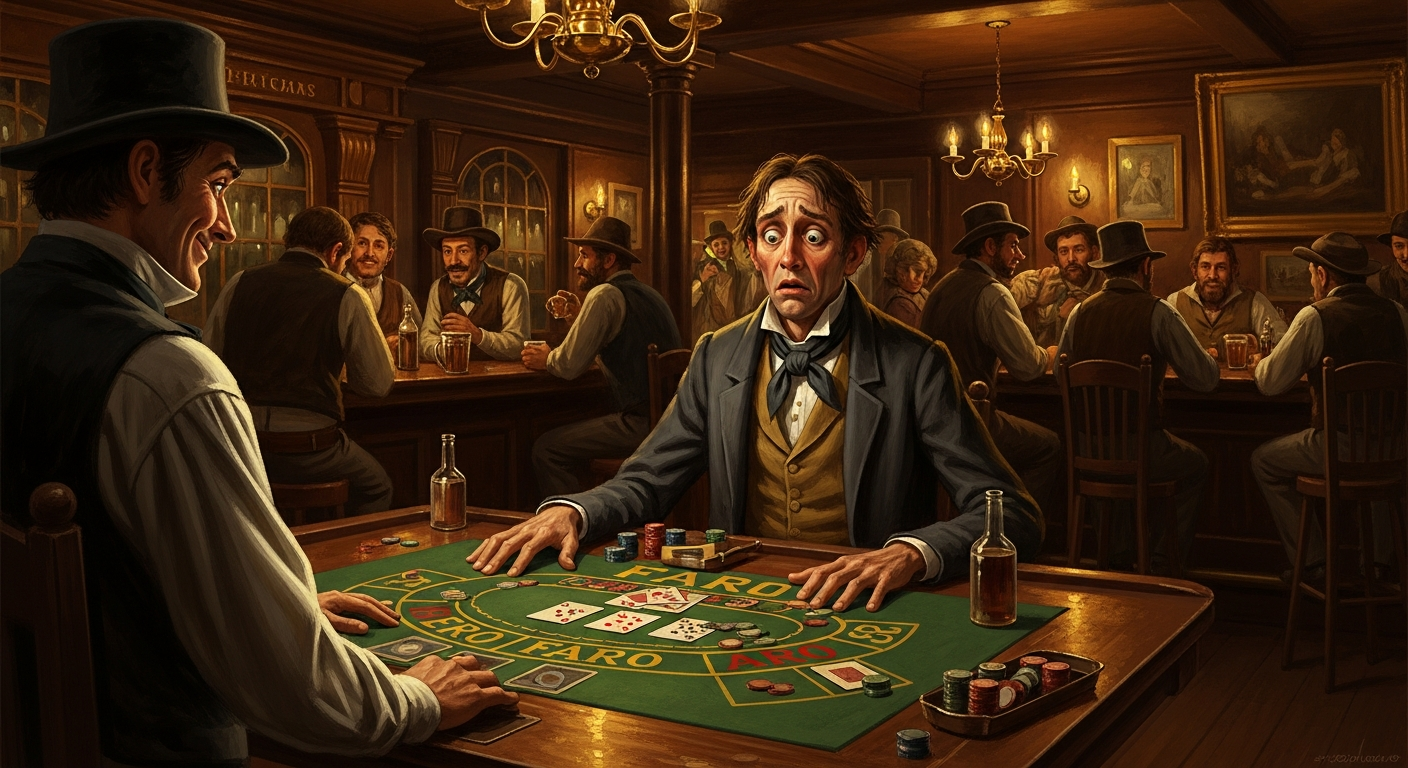
William Jones — universally known as Canada Bill — was perhaps the most singular personality in the history of American gambling. He looked like no one’s idea of a dangerous gambler. He was described as rangy, awkward, childlike in his manner, with a squeaky voice and an expression of permanent bewilderment. He wore clothes that fit badly. He seemed to have wandered in from somewhere more innocent.
It was, of course, an act. Canada Bill was a virtuoso.
He was born in England around 1820 and learned his trade from a woman called Madame Bremar, a queen of the English gambling underground who specialized in three-card monte. He brought those skills to North America and refined them to a degree that left witnesses genuinely struggling to explain what they had seen. He could run a monte game with a speed and sleight of hand that made the swindle invisible. He could deal seconds — substitute the second card for the top card without detection — while maintaining a conversation about the weather.
He partnered with George Devol, the Mississippi riverboat gambler, and together they worked the great steamboat era, fleecing passengers from New Orleans to St. Louis with games of poker, faro, and three-card monte. Devol’s apprenticeship included stints dealing faro, craps, 21, and monte. He teamed up with Canada Bill Jones, Bill Rollins, and Big Alexander.
Canada Bill was particularly attached to faro. He loved it the way some men love a bad habit they’ve tried and failed to give up — with a mixture of genuine affection and rueful self-awareness. He played it on the Mississippi boats. He played it in the frontier saloons. He played it, by multiple accounts, at tables he knew perfectly well were rigged against him.
This was the source of his most famous moment.
In a Kansas City gambling house, a companion pointed out to Canada Bill that the faro game he was approaching was being run with a gaffed dealing box — one of the mechanical cheating devices that allowed dealers to control the deal. The game was crooked. Everyone who looked carefully enough could see it. When he was asked why he played at one game that was known to be rigged, he replied, “It’s the only game in town.”
The line has been quoted ever since as the ultimate gambler’s philosophy — or the ultimate gambler’s folly, depending on your view. But there’s something else in it, something more complicated than pure compulsion. Canada Bill knew the game was rigged. He played anyway. He understood that the world is full of rigged games, and that the choice is not always between a fair game and an unfair one. Sometimes the choice is between playing the only game available on its terms or not playing at all.
Canada Bill chose to play.
He died in 1877 in Reading, Pennsylvania, essentially penniless. Several professional gamblers, who had known him from the riverboat days and felt something like fraternal obligation toward him, passed the hat to pay for his burial. The story goes that someone suggested testing the grave — putting a nail through the coffin lid — because Canada Bill had so often gotten out of tight spots before.
It’s probably not true. But it’s the kind of story that attaches itself to a man like that, because it captures something real: the sense that the rules of ordinary life barely applied to him, and that even death might have to work a little harder to hold him down.