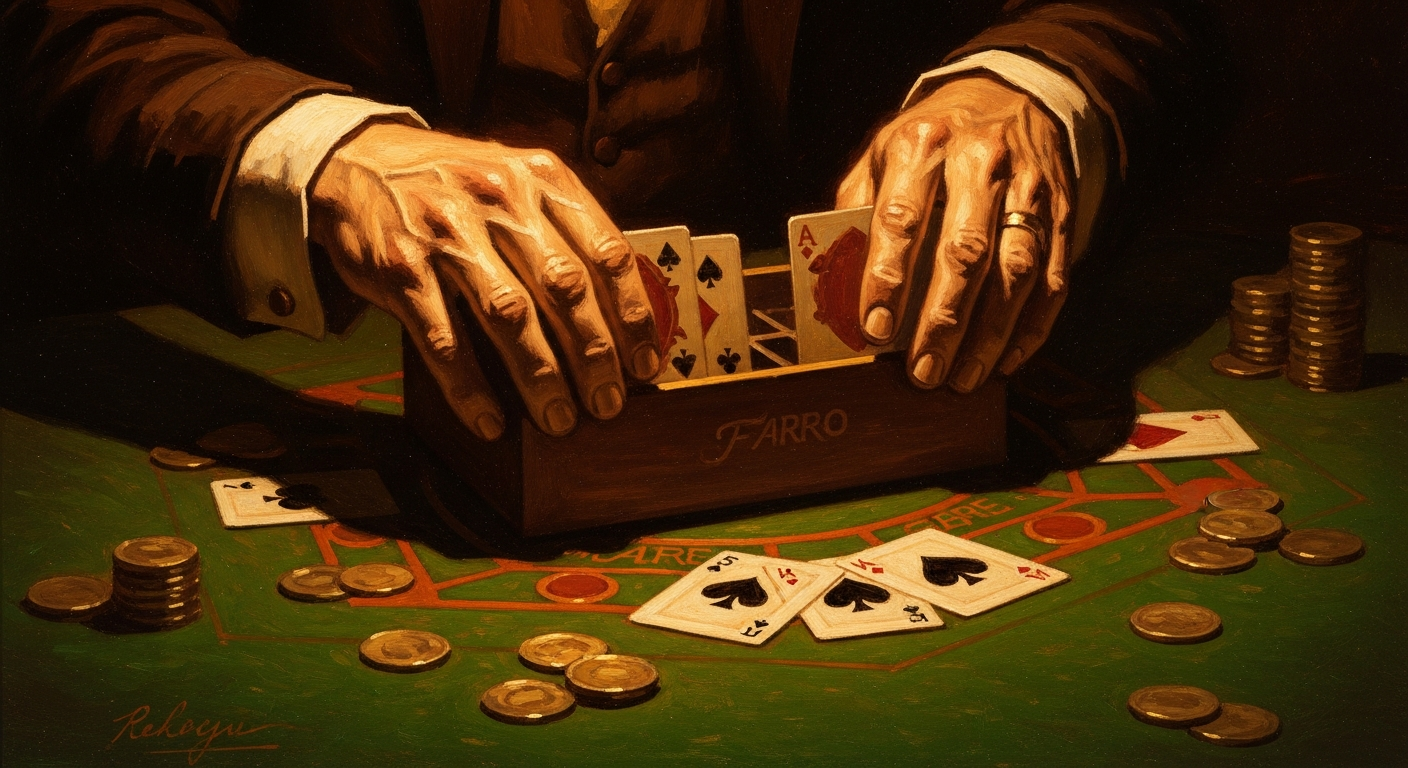
The reason faro’s fortunes ultimately collapsed was the same reason it was so beloved: it was almost fair. When these rules are reviewed, it becomes apparent that there is no significant edge for the dealer, or “house,” which resulted in cheating by the “banker” becoming commonplace.
A casino game with virtually no house edge is a casino’s nightmare. Faro bankers couldn’t run an honest game and survive financially. So they didn’t run honest games. The dealing box — the mechanical shoe that was supposed to prevent manipulation — became the primary instrument of fraud.
There were generally two kinds of cheating boxes — those that would indicate to a dealer what cards were coming up, so the dealer could discreetly shift a player’s bet off the winning card before it was drawn, and those that allowed a dealer to put through two cards simultaneously. A dealer who could produce two cards at once — creating what the trade called a “split,” where the house took half the bets — could shift the odds dramatically in the house’s favor.
Trick decks, sleight of hand, and forms of modified automatic dealing boxes were employed to give the house a better advantage. Cheating became so prevalent that editions of Hoyle’s Rules of Games book began their Faro section with a disclaimer, warning readers that an honest Faro bank could not be found in the United States.
Hoyle’s Rules of Games — the bible of card playing — essentially warned every reader: this game is rigged. Do not play it. And yet people kept playing.
One of the better-known cheating dealers was Soapy Smith, who had every one of his Faro games rigged at his Tivoli Club in Denver, Colorado. Jefferson Randolph “Soapy” Smith was one of the most audacious con men in American history, and his faro operation in Denver was a masterclass in organized deception. Every table gaffed. Every dealer trained to cheat. Every customer certain they were playing a fair game.
The faro shuffle was originally developed to gain an advantage at the game of faro. By keeping track of specific cards dealt into the winning and losing piles, the dealer would position them at the same positions in their respective halves. When the two packets are perfectly woven together, the pairs would align next to each other. The next time the cards were dealt, there would be more doublets than random chance would provide, making more money for the house.
The faro shuffle — today known to magicians and card mechanics as the “riffle shuffle” or “weave shuffle” — was literally invented as a cheating tool. Every time a modern magician performs a perfect faro shuffle, they are unknowingly demonstrating a technique developed to fleece gamblers in the frontier saloons.