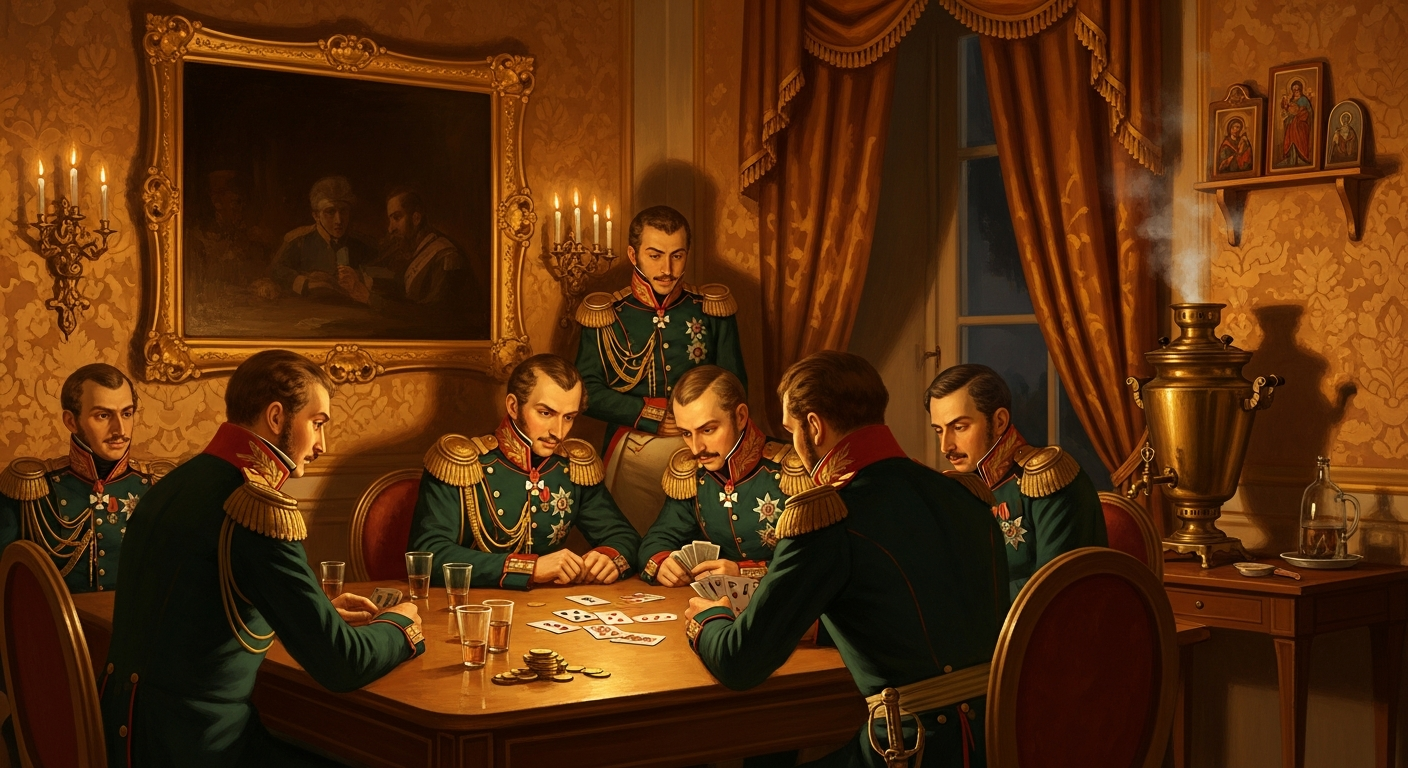
No country took faro to its dark extremes like Russia. The game — known as Pharaon or Shtoss in its Russian variants — became synonymous with aristocratic destruction. Gambling in Russia was already widespread as early as the 17th century. Card games were divided into two types: games of strategy and games of chance. The goal of games of chance was winning money. The higher the stakes, the higher the risk and hence the higher players’ excitement. Emotional intensity would captivate the player more and more – causing many to lose everything in one night.
The great writers of the 19th century Russian canon could not look away. Faro appears everywhere in their work because it was everywhere in their lives.
Alexander Pushkin was no detached observer. “Pushkin once told me rightly so, that passion for the game is the strongest of passions,” wrote Aleksey Vulf, a close friend of Pushkin’s, in his diary. Pushkin himself played faro, understood its mechanics in intimate detail, and was consumed by the obsession he diagnosed so clearly in others.
In 1833, he channeled all of it into what became one of literature’s most enduring gambling stories. In Pushkin’s The Queen of Spades, a Russian officer of German ancestry named Hermann learns that a fellow officer’s grandmother, an old countess, possesses the secret of winning at faro, a high-stakes card game. Hermann begins a liaison with Lizaveta, the countess’s impoverished young ward, to gain access to the old woman, but when the countess refuses to reveal the secret, he threatens her with a pistol and she dies of fright. The night of her funeral, he dreams that the countess has told him the winning cards — three, seven, and ace. Hermann then places bets on the three and seven and wins. After betting everything on the ace, which wins, Hermann is horror-stricken to see that he is holding not the ace but the queen of spades, who seems to smile up at him as did the countess from her casket.
The stakes in Pushkin’s story were not fictional exaggeration. In Hermann’s game there was 188,000 roubles at stake — a gigantic amount of money for those times. At a real faro table, fortunes of that magnitude were wagered and lost.
Tchaikovsky later adapted the story into his famous opera, cementing the three, seven, and ace as the most sinister sequence of cards in the Russian imagination.
Tolstoy dramatized the devastation just as vividly. In a famous scene from Leo Tolstoy’s War and Peace, Nicholas Rostov loses 43,000 rubles to Dolokhov playing faro. Rostov is young, naive, and entirely outmatched by the calculating Dolokhov, who seduces him into raising his stakes again and again until the loss is catastrophic. It is one of literature’s most precise accounts of how faro could annihilate a man in a single evening.
In Fyodor Dostoevsky’s novel The Brothers Karamazov, Dmitri Karamazov is cheated out of 200 rubles by two Polish officers in a game of faro when they switch an unopened deck of cards for a marked set. Dostoevsky knew this world from the inside. Financial troubles resulting from faro-induced gambling debts clouded Dostoevsky’s later years.
And in Barry Lyndon, William Thackeray’s morality tale of an Irish adventurer, the main character runs a crooked faro bank, alternately to his great fortune or ruin. Stanley Kubrick later adapted the novel into one of cinema’s masterpieces, preserving faro’s central role in a candlelit scene that has become iconic.