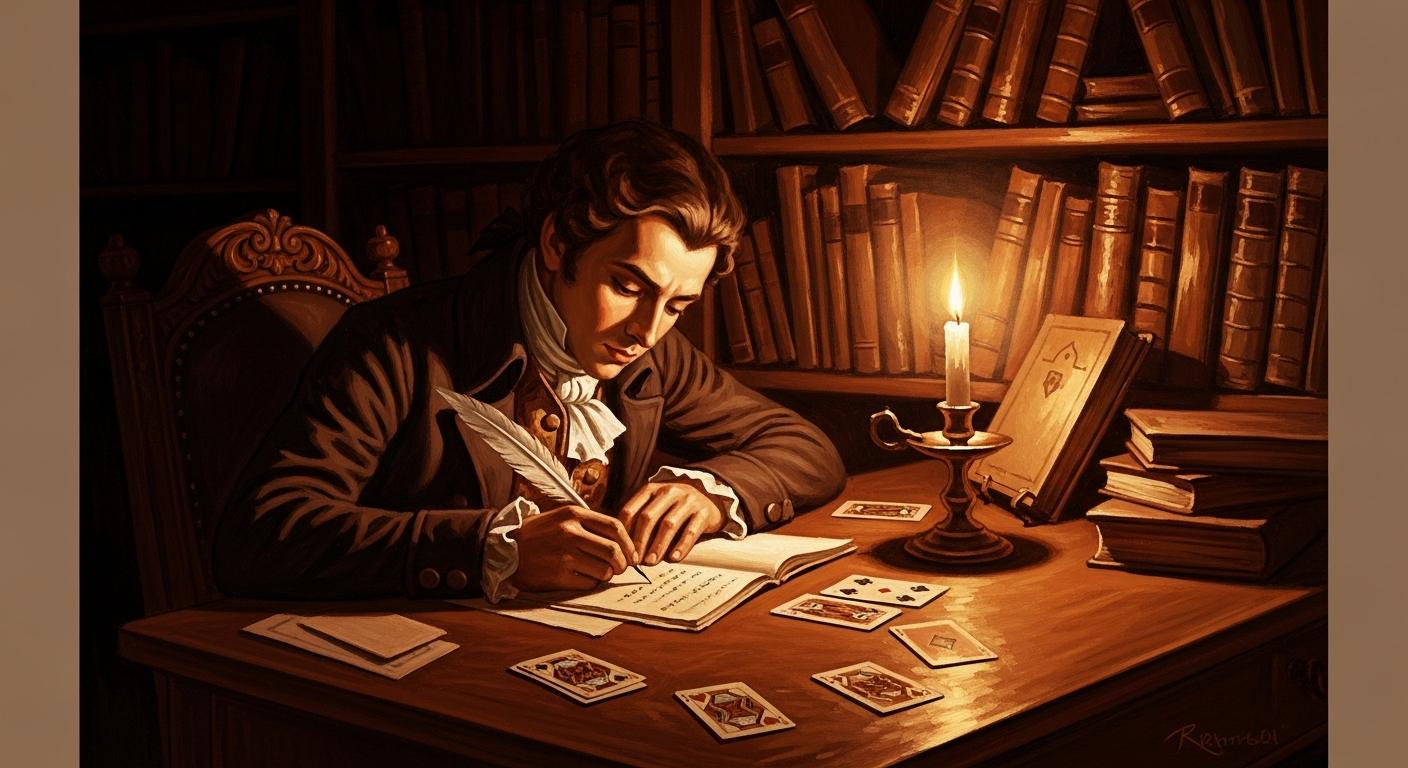
In 1833, Alexander Pushkin — already the most celebrated writer in Russia, a man who had been exiled twice by the Czar and had survived duels that would have killed anyone less charmed — sat down and wrote a short story about faro.
It became one of the most famous pieces of fiction in the Russian language. Tchaikovsky later turned it into an opera that is still performed in major houses around the world. The central image — a dying countess, a desperate gambler, a ghost, three magic cards — has embedded itself so deeply in Russian culture that educated Russians of the 19th century knew the sequence by heart: three, seven, ace.
But what made Pushkin able to write it so precisely was that he wasn’t inventing anything. He was writing what he knew.
“Pushkin once told me rightly so, that passion for the game is the strongest of passions,” wrote Aleksey Vulf, a close friend of Pushkin’s, in his diary. Pushkin played faro. He understood its mechanics, its psychology, and its capacity for destruction from the inside.
In the story, a Russian officer of German ancestry named Hermann learns that a fellow officer’s grandmother, an old countess, possesses the secret of winning at faro, a high-stakes card game. Hermann begins a liaison with Lizaveta, the countess’s impoverished young ward, to gain access to the old woman, but when the countess refuses to reveal the secret, he threatens her with a pistol and she dies of fright. The night of her funeral, he dreams that the countess has told him the winning cards — three, seven, and ace. Hermann then places bets on the three and seven and wins. After betting everything on the ace, which wins, Hermann is horror-stricken to see that he is holding not the ace but the queen of spades, who seems to smile up at him as did the countess from her casket.
The genius of the story is its complete ambiguity. Did the countess’s ghost actually visit Hermann? Or did a guilty, obsessed, sleepless man simply hallucinate the cards he wanted to see? Pushkin never tells you. He understood — from his own time at the faro table — that gambling operates in exactly this space: between the rational and the magical, between what the odds say will happen and what you desperately need to believe.
What Pushkin captured about faro — and what no other game quite produces — is the specific madness of a game where you watch the cards come out one by one, where you know exactly what has been played and can calculate what remains, and where you still lose. Hermann knows he has the ace. He watched the three win, watched the seven win, laid everything he has on the ace with complete conviction.
And he turns over the queen of spades.
As we know, Alexander Pushkin was an inveterate gambler himself, and was very well versed in the subtleties of the game. In Pushkin’s time, a player could come to the game with his own deck. When the bets became high — and in Hermann’s game there was 188,000 rubles at stake, a gigantic amount of money for those times — for safety reasons both the player and the banker opened out a new deck.
188,000 rubles. In a single faro session. In 1830s Russia. The scale of what the aristocratic class was willing to stake on the turn of a card is almost incomprehensible — and Pushkin made sure his readers understood that the stakes in his story were real, not literary invention.
Pushkin himself died in a duel in 1837, four years after writing the story. He was 37. In some ways, his life followed the same arc as his gambling: brilliant, spectacular, and cut short by a moment of passion from which no amount of calculation could save him.
He left behind a story in which faro is not merely a game but a metaphor for every transaction between desire and fate — the three, the seven, and the ace that turns into the queen of spades at the moment of certainty.