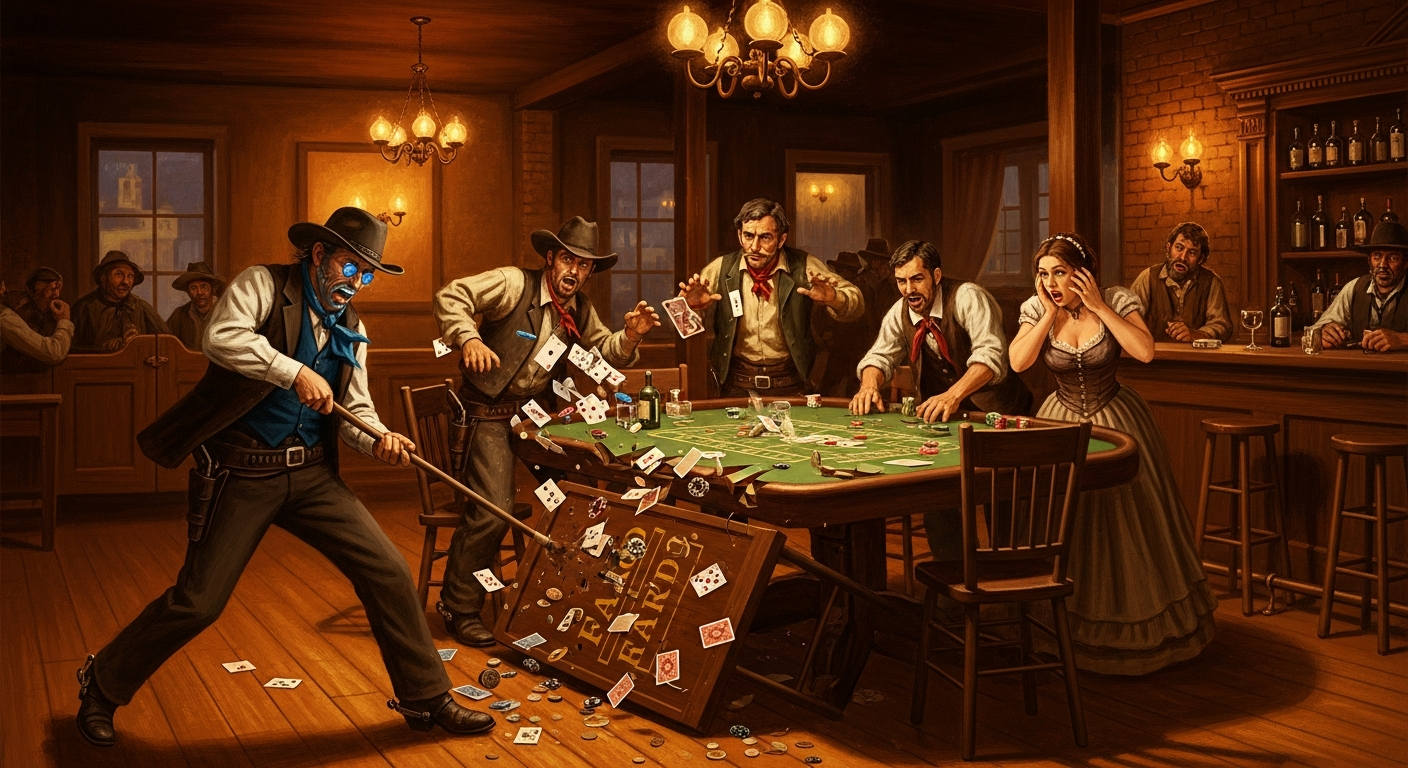
This story comes from George Devol himself, who recorded it in his 1892 memoir, Forty Years a Gambler on the Mississippi, with his characteristic mixture of showmanship and precision.
Devol was working a faro table in the Gold Room Saloon in Cheyenne, Wyoming Territory, in 1874. One day a strangely familiar gent, with blue-tinted spectacles and his hat pulled low on his forehead, sauntered up to a gaming table and placed a $50 bet, which he promptly lost.
Devol recognized the man but kept his recognition to himself. That was the professional approach. In the gambling world, you didn’t advertise who was at your table.
The stranger placed the same $50 bet again. This time he won. He pushed his winnings toward the dealer and waited for his payout.
The dealer handed him $25.
“But you took 50 when I lost,” said the man. “Fifty goes when you lose,” replied the dealer.
This was the house’s crooked edge laid completely bare: the limit applied only to winning bets, not to losing ones. You could lose $50, but you could only win $25. It was highway robbery with a thin veneer of procedural justification.
The stranger had come to the table looking to play faro. He had lost once, accepting the risk. He had won the second time and discovered that the win didn’t count at full value. He had been cheated, clearly and openly, in the middle of a public room.
Without warning, the furious player whacked the dealer and his partner over the head with his walking stick, toppled the table, and began stuffing his pockets with the contents of the till.
The blue-tinted spectacles came off during the chaos. Devol recognized the face beneath them — a famous face, one known across the American West.
Devol never named the man in print. Some historians have speculated. The blue-tinted spectacles, the hat pulled low, the deliberate disguise — it reads like a man who knew he would be recognized and was trying, with limited success, to avoid it. Whoever he was, he’d had enough of the crooked house limit, demonstrated it with a walking stick, took his money back with interest, and walked out of the Gold Room Saloon and back into whatever life he was living when he wasn’t teaching crooked faro dealers a lesson.
Devol admired him for it. A gambler who enforced his own justice against a rigged game was, in the ethics of the frontier gambling world, doing exactly the right thing.
The table stayed overturned. The dealer nursed his head. Cheyenne went on about its business.
And the man with the blue-tinted spectacles disappeared into the Wyoming afternoon, his walking stick apparently undamaged, his business apparently concluded.