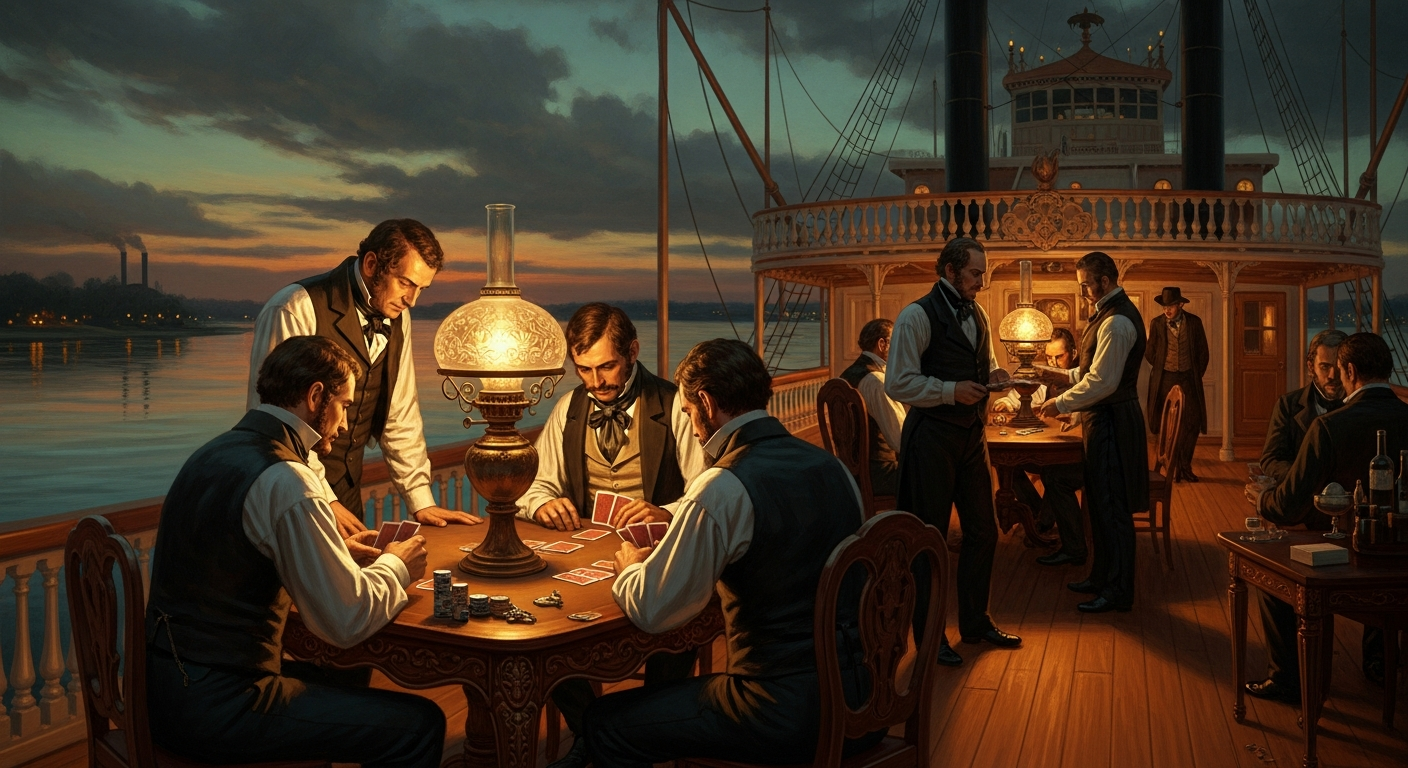
The steamboat was to faro what the internet is to modern commerce: a distribution network of unparalleled reach. By the 1830s, the Mississippi and its tributaries carried thousands of passengers between New Orleans, Natchez, Memphis, St. Louis, and Cincinnati — and where passengers went, professional gamblers followed.
Some of the first gambling dens outside of New Orleans were started in river towns that were popular with both travelers and professional gamblers. It was here that many “sharpers” preyed on these transient people, with their pockets filled with their life savings, on the way to the new frontier.
John Davis opened the first American gambling casino in New Orleans around 1822. The club, open 24 hours a day, provided gourmet food, liquor, roulette wheels, Faro tables, poker, and other games. Davis also made certain that painted ladies were never far away. Dozens of imitators soon followed, making the gaming dens the primary attraction of New Orleans.
Into this world stepped George H. Devol — perhaps the most colorful gambler in American history. George H. Devol was the greatest riverboat gambler in the history of the Mississippi River. He was also a con artist, a fighter, and a master at manipulating men and their money. Born on August 1, 1829, in Marietta, Ohio, Devol ran away at the age of ten, serving as a cabin boy on a riverboat steamer.
By his teenage years, Devol had already mastered the dark arts of card manipulation. By the time Devol was in his teens, he could deal bottoms and seconds, palm cards, and recover the cut. His apprenticeship as a blackleg included stints dealing faro, craps, 21, and monte.
One trick that Devol liked to play was betting against ministers, who inevitably lost their meager wages to the professional gambler. However, Devol would always return their money, along with this advice: “Go and sin no more.” But to the many soldiers, paymasters, farmers, thieves, and businessmen, he was not so kind.
Devol teamed up with the legendary Canada Bill Jones — the greatest three-card monte operator who ever lived — and together they carved a trail of spectacular cons up and down the river. Canada Bill was famous for playing faro even when he knew the game was crooked. The 19th-century scam artist Canada Bill Jones loved the game so much that, when he was asked why he played at one game that was known to be rigged, he replied, “It’s the only game in town.”
Devol claimed to have won over two million dollars in his career. It is estimated that Devol won over two million dollars in his forty years of gambling. However, when he died in Hot Springs, Arkansas, in 1903, he was nearly penniless. In 1892, he published his memoir, Forty Years a Gambler on the Mississippi, one of the most vivid documents of 19th-century American gambling life ever written.
In his 1892 autobiography, Devol described a remarkable brush with a celebrity in 1874. Devol was working in the Gold Room saloon in Cheyenne, Wyoming Territory, at the time. One day a strangely familiar gent, with blue-tinted spectacles and his hat pulled low on his forehead, sauntered up to a gaming table and placed a $50 bet, which he promptly lost. The fellow placed the same bet again and this time won. When the dealer handed over only $25, the stranger protested and was told, “the house limit’s 25.” “But you took 50 when I lost,” said the man. “Fifty goes when you lose,” replied the dealer. Without warning, the furious player whacked the dealer and his partner over the head with his walking stick, toppled the table and began stuffing his pockets with the contents of the till. The mystery man was never conclusively identified, which only made the story better.