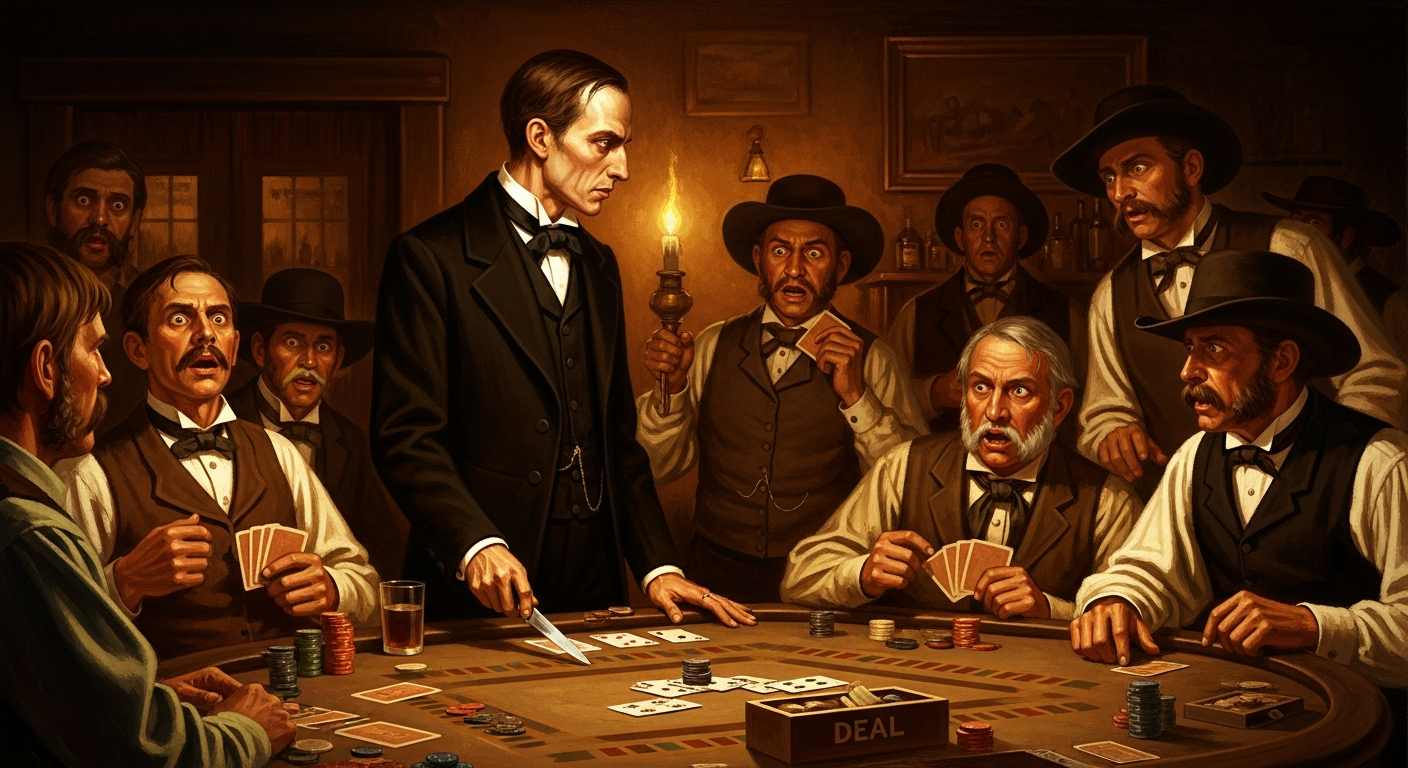
Fort Griffin, Texas. 1875. Doc Holliday was twenty-four years old, already dying, and making his living running a faro bank.
John Henry Holliday had graduated from the Pennsylvania College of Dental Surgery. He had moved to Dallas, Texas, to practice. Then he was diagnosed with tuberculosis. The prognosis was months. He was told to go west, to drier air, to buy whatever time was left.
He went west. The time stretched into years. And along the way, he discovered that dealing faro paid better than pulling teeth and required considerably less optimism about the future.
By the time Holliday arrived in Fort Griffin — a raw, violent supply town on the Texas frontier — he had already developed the reputation that would follow him for the rest of his life. Thin, pale, coughing, with hands so fast and precise from years of card handling that other gamblers watched them the way soldiers watch a man reaching for his gun.
At the faro table in Fort Griffin, a man named Ed Bailey sat down to play.
Bailey was a bully of the particular frontier variety — a man whose size had given him a lifetime of impunity and who had never encountered consequences sufficient to teach him restraint. Bailey was unimpressed with Doc’s reputation, and in an attempt to irritate him, he kept picking up the discards and looking at them.
In faro, this was not a minor transgression. The discard pile was the record of cards already played. Examining it was a form of cheating — it gave a player information they weren’t entitled to, and the rules of frontier faro were explicit: you didn’t touch the discards. Every serious player in the room knew it. Ed Bailey knew it too.
Though Holliday warned Bailey twice, the bully ignored him and picked up the discards again. This time, Doc raked in the pot without showing his hand or saying a word.
This was the correct application of faro protocol. A player who cheated forfeited. Holliday didn’t need to raise his voice or threaten anyone. He simply enforced the rules with absolute calm.
Bailey did not accept this calmly. He had just lost his bet and his dignity simultaneously, in front of a room full of men who could see exactly what had happened. Bailey immediately brought out his pistol from under the table, but Doc’s lethal knife slashed the man across the stomach before the man could pull the trigger. With blood spilled everywhere, Bailey lay sprawled out dead across the table.
The room was chaos. Holliday was arrested — technically, he had killed a man in a gambling hall, and the law, however loosely administered on the Texas frontier, had to be seen to do something. He was taken to a hotel room to await whatever passed for justice in Fort Griffin.
He didn’t wait long. A woman named Big Nose Kate — his companion and, depending on which account you believe, the love of his complicated life — set fire to an outbuilding to create a diversion, then held a guard at gunpoint while Holliday walked out.
The two of them rode out of Fort Griffin that night and didn’t stop until they were in Kansas.
The faro table that started it all stayed behind. The blood on the green baize was cleaned up, or wasn’t. A new dealer took the chair. The cards were reshuffled. The next hand was dealt.
That was faro’s world. Violence was a weather condition — it came and it passed, and then the game resumed.