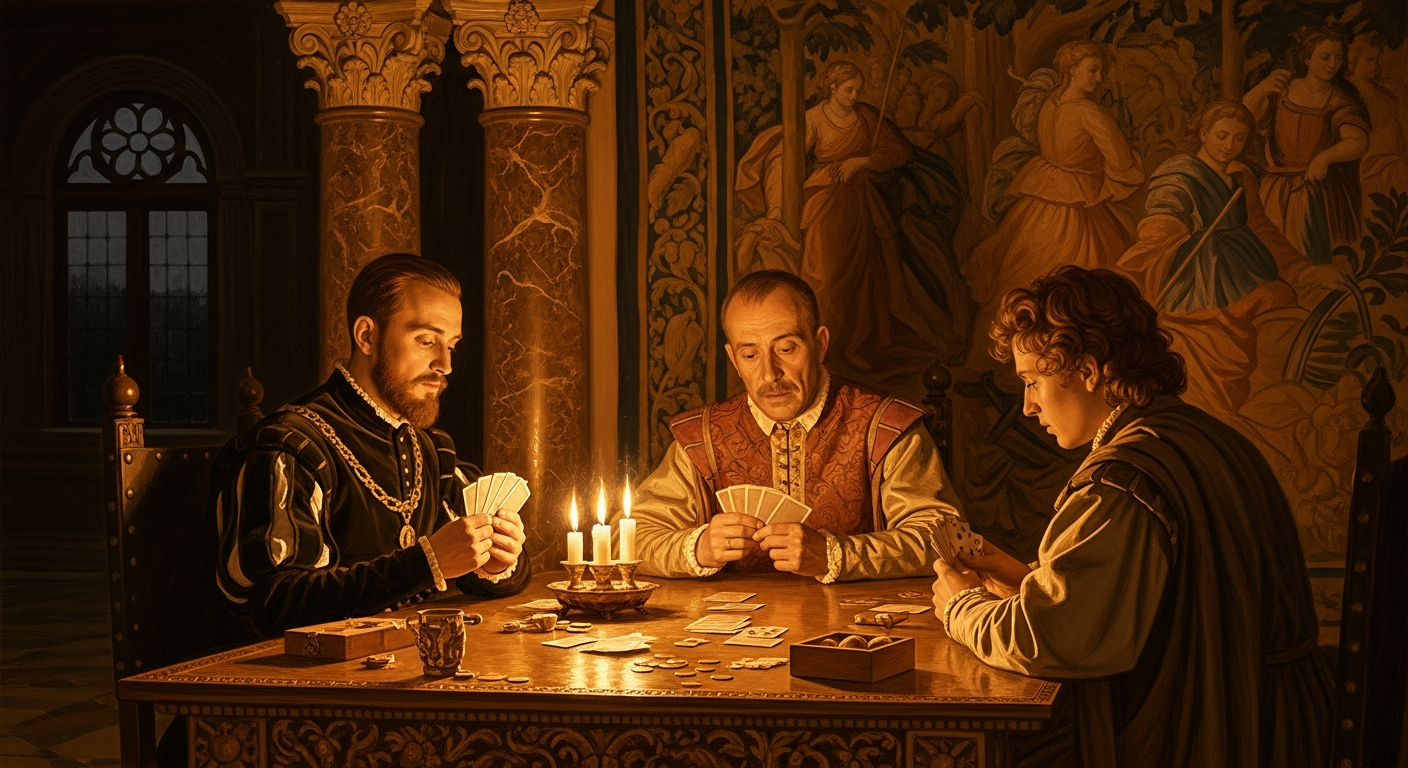
Every game has a parent, and Faro’s was a shadowy Italian game called Bassetta — or Bassette, or Barbacole, or Hocca, depending on which alley you were playing it in. Faro is a derivative of the game Bassetta, which was brought to Paris from Italy in the early 17th century. Its origins can be traced back to as early as the 15th century.
Italy in the 1400s and 1500s was a civilization of extremes — extraordinary beauty and extraordinary vice coexisting in the same palaces. Card games were an aristocratic obsession, and banking games, where one player held the bank against all comers, became particularly fashionable because they were fast, simple, and involved the delicious theater of pure chance. Bassetta was the apex of this tradition: a game of elegant brutality where fortunes could change hands in minutes.
When the Venetian ambassador brought Bassetta to Paris in 1672, he introduced it to arguably the most powerful court in the world — the court of Louis XIV. The game landed in fertile soil. The French aristocracy, already obsessed with gambling, took to it with ferocity.