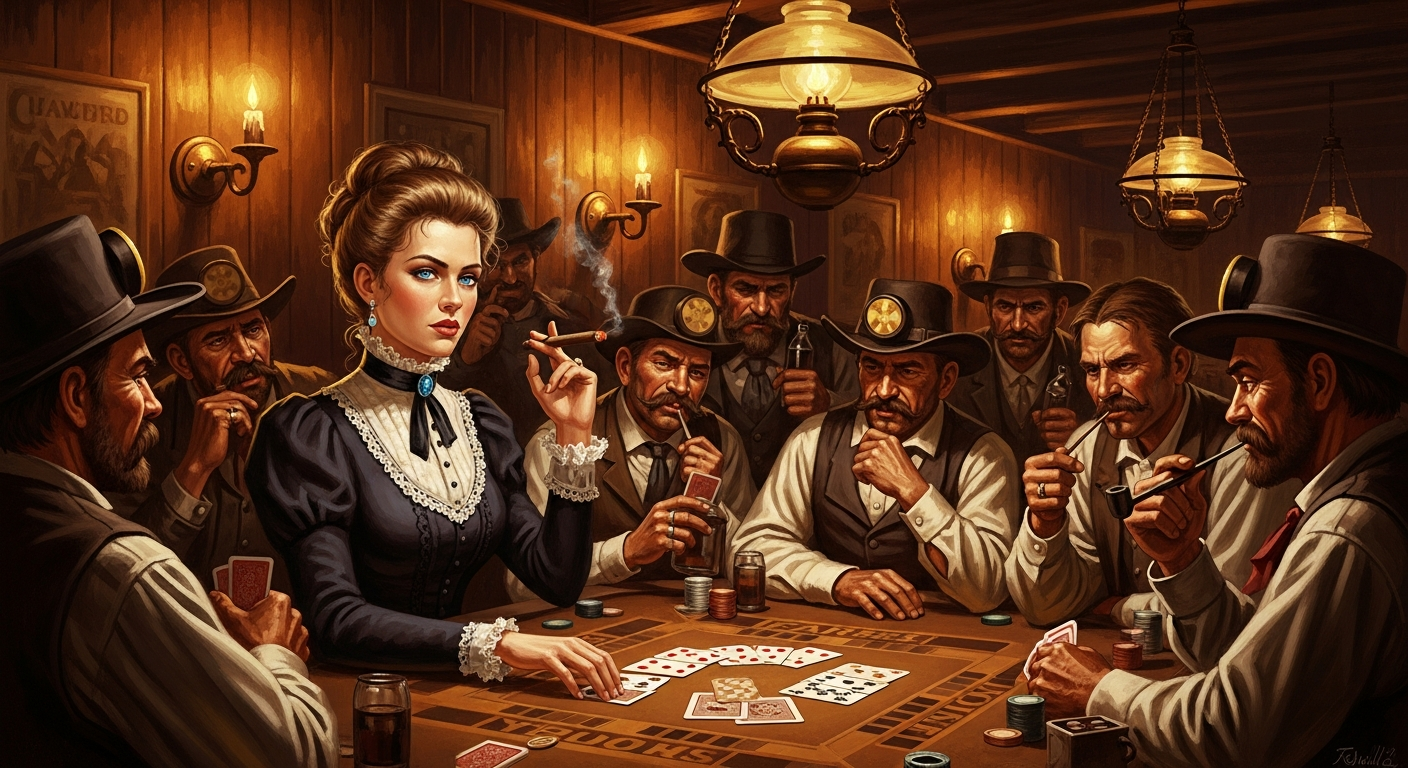
She was born in Devonshire, England, in 1851, the daughter of Irish immigrants. Ivers moved with her family to Virginia at the age of 12. She received a proper education. She was refined. She was a lady.
By the time she died, in a hospital bed in South Dakota in 1930, she had dealt faro in the most dangerous gambling dens in the American West, shot at least one man with a .38-caliber revolver, killed a soldier during a raid on her saloon, run a brothel, been arrested for bootlegging during Prohibition, and won what she estimated to be $250,000 at the gaming tables — and lost most of it.
She was Alice Ivers. The world called her Poker Alice.
Her first husband, Frank Duffield, was a mining engineer who liked to gamble. When he brought his young wife to the saloons and gaming halls of Leadville, Colorado, Alice stood quietly behind her husband, simply watching the play. However, after a brief study, she was soon sitting in on the games, demonstrating proficiency in poker and faro.
Then Frank died in a mining accident, the way so many men died in those Colorado hills. Alice was widowed, alone, in a mining camp, with no school to teach at and no prospect of conventional income. Though she preferred poker, she also learned to deal and play Faro and was soon in high demand as both a player and a dealer. At this time, Alice was a petite 5’4” beauty with blue eyes and lush brown hair. A “lady” in a gambling hall that wasn’t of the “soiled dove” variety was rare in the Old West, and adorned in the latest fashions, she was a sight for the sore eyes of many a miner.
She was also, it turned out, genuinely extraordinary at cards.
Some nights she would make $6,000, an incredibly large sum of money at the time. She claimed that she won $250,000. She had a famous poker face — while most women of the time were expected to smile often and show emotion, Alice would chomp on her cigar and show no emotion whatsoever. It was an act of calculated defiance: the cigar, the expressionless stare, the refusal to perform femininity at the table. It rattled men. She knew it rattled them. She used it like a weapon.
After a large win, she made trips to New York City to replenish her wardrobe of fashionable clothing. Alice cycled between extremes in a way that defined her life: she would win spectacular sums at the faro table or the poker table, then spend it all in Manhattan department stores on the kind of dresses that would give her a competitive edge the next time she sat down across from a miner. Investment dressed as extravagance.
She dealt faro in Bob Ford’s saloon in Creede, Colorado — the same Bob Ford who had famously shot Jesse James in the back. She won $6,000 in one night at the Gold Dust Gambling House in Silver City, New Mexico, and immediately took the train to New York.
She dealt faro in Deadwood, South Dakota, where she met her second husband, Warren Tubbs, a fellow dealer. A drunken miner tried to attack Warren with a knife, causing her to threaten the miner with her .38 firearm. She married Tubbs, had seven children with him, and moved to a ranch near Sturgis where she tried, briefly, to live like a normal person.
It didn’t take. During the great blizzard of 1910, Tubbs, who suffered from tuberculosis, contracted pneumonia and died. After the winter storm subsided, Poker Alice loaded her husband’s frozen body into a wagon, hitched up the horses, and drove into Sturgis where she pawned her wedding ring to pay for the burial. Afterward, she went to the local gambling hall and asked if she could work a shift. Poker Alice took the money she earned, bought back her wedding ring, and returned to the family ranch. She would fondly recall Tubbs as the love of her life.
That sequence of events — the frozen body in the wagon, the wedding ring pawned for a burial, the shift worked to buy the ring back — is one of the most quietly extraordinary moments in the entire history of American gambling. It captures everything about who Alice was: unsentimental, resourceful, unbreakable, and deeply devoted beneath the armored exterior.
She went back to dealing. She eventually opened her own establishment between Sturgis and Fort Meade — a gambling house and saloon she called Poker’s Palace. In 1913, soldiers from nearby Fort Meade came looking for trouble and found it: Alice fired through a window to stop them from breaking in, and a soldier was killed. She was arrested. She awaited trial smoking cigars and reading the Bible. She was acquitted on self-defense grounds.
Later, during Prohibition, she was arrested again for bootlegging. Alice was convicted for violating the Prohibition law but never served the sentence. Governor W. J. Bulow pardoned her, saying: “I can’t send a white-haired old woman to jail on a liquor charge.”
She died in 1930 at the age of 79, following surgery for gallstones. Poker Alice was English born but American bred, and always the gambler. She started as a faro dealer.
Her will settled all accounts with characteristic bluntness. Her will read: “I hereby specifically disinherit each and every one of my relatives and kin, for the reason that they have not contributed to my welfare and happiness during the declining years of my life, nor have they made any effort to inquire as to my welfare for a great number of years.”
She left her chickens to one neighbor, her crops to another. And she left behind a lifetime of faro and poker played on her own uncompromising terms, across the most dangerous rooms in the American West, without flinching and without apologizing for a single hand.
Her favorite saying: “Praise the Lord and place your bets. I’ll take your money with no regrets.”